Independent & evidence-basedPeer-reviewed citationsUpdated monthlyFree monthly research digest
Research

Key MOTS-c peptide studies

Last reviewed: · Reviewed by the mots-c.com Editorial Team

A curated, regularly updated list of the most important peer-reviewed MOTS-c research — from the 2015 discovery paper to recent work on exercise, aging, and metabolic disease. Each entry links directly to PubMed.

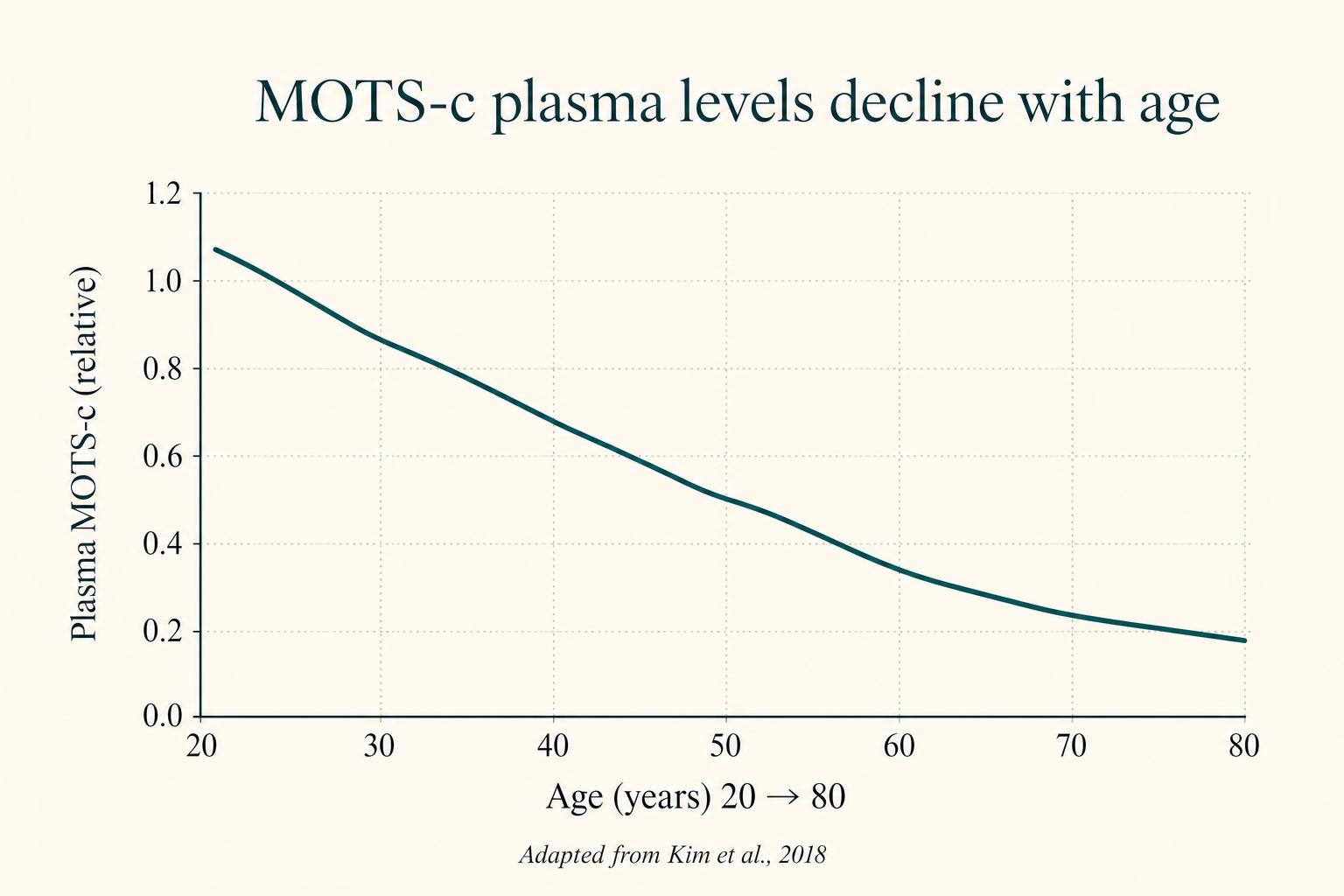
Plasma MOTS-c levels decline with age — line chart from age 20 to 80, adapted from Kim et al. 2018
One of the most-cited findings: plasma MOTS-c declines with age in healthy adults (adapted from Kim et al., 2018).

How we evaluate MOTS-c studies

We weight studies along four axes before deciding whether to include them: (1) species and translatability — human > primate > rodent > cell line; (2) randomization and blinding; (3) effect size relative to control; and (4) replication by an independent group. The list below is curated, not exhaustive — we favor papers that have shaped how mitochondrial-derived peptides are understood, not every paper that mentions MOTS-c.

By research area

Metabolism & insulin

Lee et al. 2015; Du et al. 2017; Wu et al. 2021.

Exercise & aging muscle

Reynolds et al. 2021; Yin et al. 2023.

MOTS-c levels in humans

Kim et al. 2018; Du et al. 2017.

Reviews & mechanisms

Wu et al. 2021; Yin et al. 2023.

Key studies, in chronological order

  1. 2023Frontiers in Physiology

    MOTS-c: A Novel Mitochondrial-Derived Peptide Regulating Muscle and Fat Metabolism

    Yin X., Jing Y., Chen Q., et al.

    Recent review focused on MOTS-c effects on skeletal muscle and adipose tissue.

    View on PubMed →
  2. 2021Nature Communications

    MOTS-c is an exercise-induced mitochondrial-encoded regulator of age-dependent physical decline and muscle homeostasis

    Reynolds J.C., Lai R.W., Woodhead J.S.T., et al.

    MOTS-c administration restored physical performance in aged mice — strongest effects in the oldest animals.

    View on PubMed →
  3. 2021Endocrine Connections

    MOTS-c functionally prevents metabolic disorders

    Wu Y., Sun L., Zhuang Z., et al.

    Comprehensive review of MOTS-c mechanisms across metabolic diseases including NAFLD and type 2 diabetes.

    View on PubMed →
  4. 2018Aging

    Naturally occurring mitochondrial-derived peptides are age-dependent regulators of apoptosis, insulin sensitivity, and inflammatory markers

    Kim S.J., Mehta H.H., Wan J., et al.

    Establishes that circulating MOTS-c levels decline with age and correlate with insulin sensitivity in humans.

    View on PubMed →
  5. 2017Journal of Diabetes

    Plasma MOTS-c levels are associated with insulin sensitivity in lean but not in obese individuals

    Du C., Zhang C., Wu W., et al.

    First human correlational data linking lower MOTS-c to insulin resistance.

    View on PubMed →
  6. 2015Cell Metabolism

    The mitochondrial-derived peptide MOTS-c promotes metabolic homeostasis and reduces obesity and insulin resistance

    Lee C., Zeng J., Drew B.G., et al.

    The original discovery paper. Identifies MOTS-c as a mitochondrially encoded peptide and shows it prevents obesity and insulin resistance in mice.

    View on PubMed →
Open questions in current MOTS-c research

  • What is the optimal dose, frequency, and duration in humans?
  • How much of exercise's metabolic benefit is downstream of endogenous MOTS-c?
  • Are there long-term safety signals over multi-year administration?
  • Do MOTS-c benefits depend on baseline mitochondrial health and age?
  • How do common MOTS-c gene variants (e.g. K14Q in some Asian populations) affect endogenous activity and exogenous response?

Get new MOTS-c studies in your inbox

When a notable new study is published, we summarize it in plain English and send it your way.